Advertisers planning campaigns and listeners looking for something to hear are increasingly asking AI assistants such as ChatGPT, Claude, Gemini and Perplexity, and radio sales and programming leaders say local stations are mostly missing from the answers.
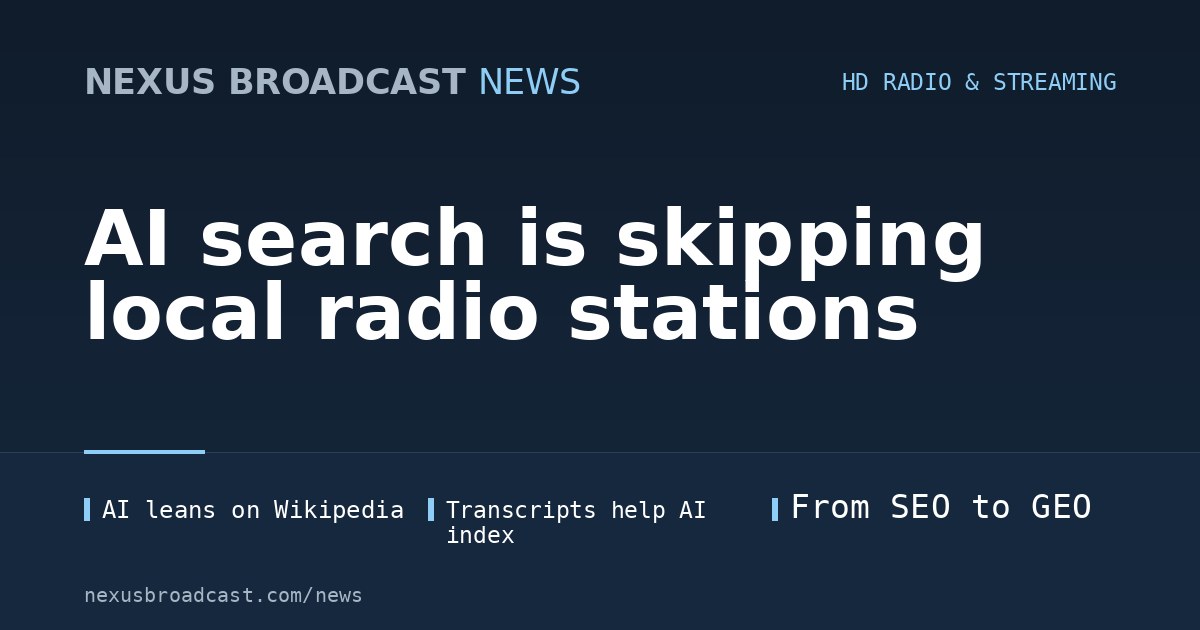
Dave Casper, senior VP of digital services at the Radio Advertising Bureau, said the core problem is that radio is audio, and the models can only learn what stations publish in text. "AI can't see a lot of what radio does because radio is audio," he said. With little station content to draw on, he said, AI tools often fall back on Wikipedia or old Chamber of Commerce articles. "A lot of radio stations probably haven't looked at their Wikipedia page since 2005," Casper said. He recommended stations keep a marketing blog that explains what they offer local advertisers, and said RAB suggests using tools like Claude or ChatGPT to build web pages designed for AI to read.
Jerry Del Colliano, publisher of Inside Music Media, said a request for listening options is likely to bring up Spotify playlists, YouTube Music, SiriusXM or a national podcast ahead of any local station, and that "broadcasters risk losing visibility before losing listeners." Chris Brunt, director of digital revenue generation and AI for Jacobs Media, said media website traffic has fallen sharply in 2026 as people read Google's AI summaries instead of clicking through.
Gordon Borrell, president and CEO of Borrell Associates, said AI search leans heavily on Reddit and on structured listings such as Google Business profiles, Apple Business Connect, Yelp, Facebook and directories. He also cautioned that the assistants tailor answers to the person asking, so a salesperson who asks a lot of radio questions will tend to get radio-friendly results.
The practice of shaping content for these tools is being called generative engine optimization, or GEO. The approaches discussed include writing web copy around the plain questions people ask (how to listen to a station in a given city, what airs on a certain day), opening pages and DJ bios with a short direct summary, building FAQ pages on streaming, contests, events and ad rates, and posting transcripts of interviews, local news and specialty shows so the spoken content can be indexed.
For a small station, a practical starting point is to search for itself in a few AI assistants, see what comes back, and check that its Wikipedia entry, business listings and website say what it wants advertisers and listeners to know.