
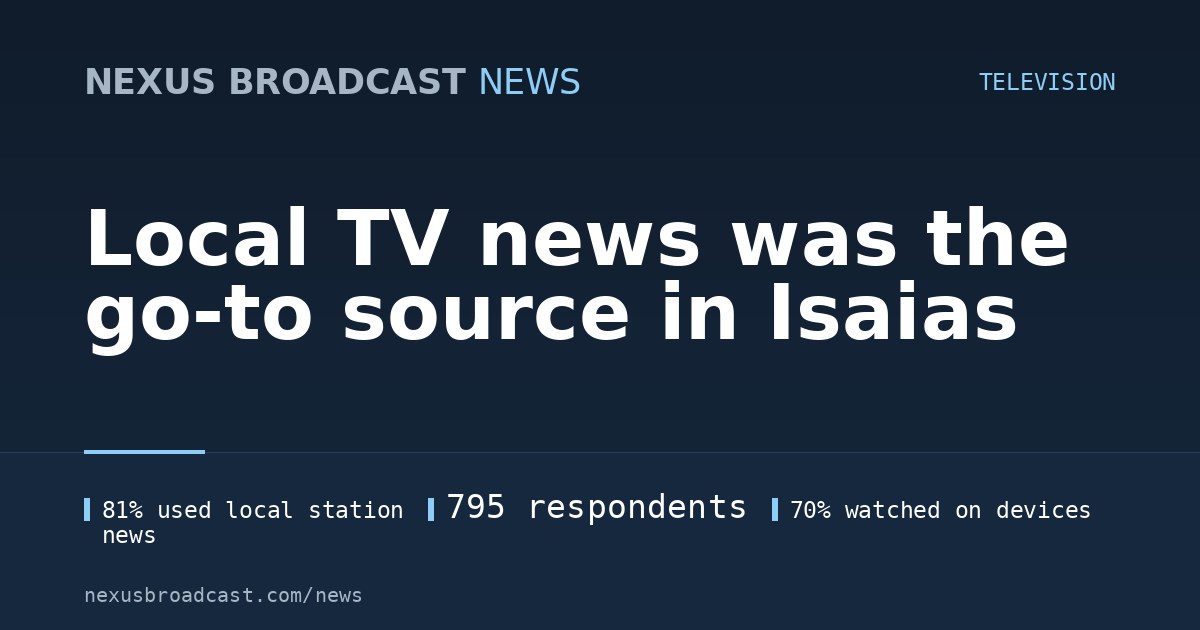
Local television stations were the first place most people turned during Hurricane Isaias, according to a survey commissioned by the Television Bureau of Advertising (TVB) and fielded by Dynata. Of 795 respondents, 81% said they used some form of local broadcast station news for storm information, whether on air, online, in an app or on a streaming service.
Broken out by individual source, over-the-air local TV station news was used by 64% of respondents. Phone emergency alerts reached 50%, network national news 46%, social media 44%, and local station news carried on a streaming service 42%.
TVB's numbers show local station news as the most important source at every stage of the storm: 42% before landfall, 49% during the storm and 41% afterward. Phone alerts mattered most early on, at 17% before the storm, then fell to 9% afterward, when social media rose to 13%.
Viewing was not limited to the living room. Seventy percent of respondents said they watched a live local newscast on a smartphone, computer or tablet at some point during the emergency. Asked why they watched broadcast TV news, 74% cited wanting information about their own area and 69% cited trust. For station websites, apps and streaming, the leading reasons were local information at 68%, trust at 62% and public-service information at 45%, with convenience at 36% and access from anywhere at 35%.
On trust, local station news on a streaming service scored 90%, local TV station news 88%, and station websites, apps and dedicated streaming news apps 87%. The survey also ranked local stations as the outlets most involved in their communities before, during and after hurricanes.
For stations heading into severe-weather season planning, the figures point to how much of the emergency audience now reaches local coverage through apps, websites and streams rather than the broadcast signal alone.